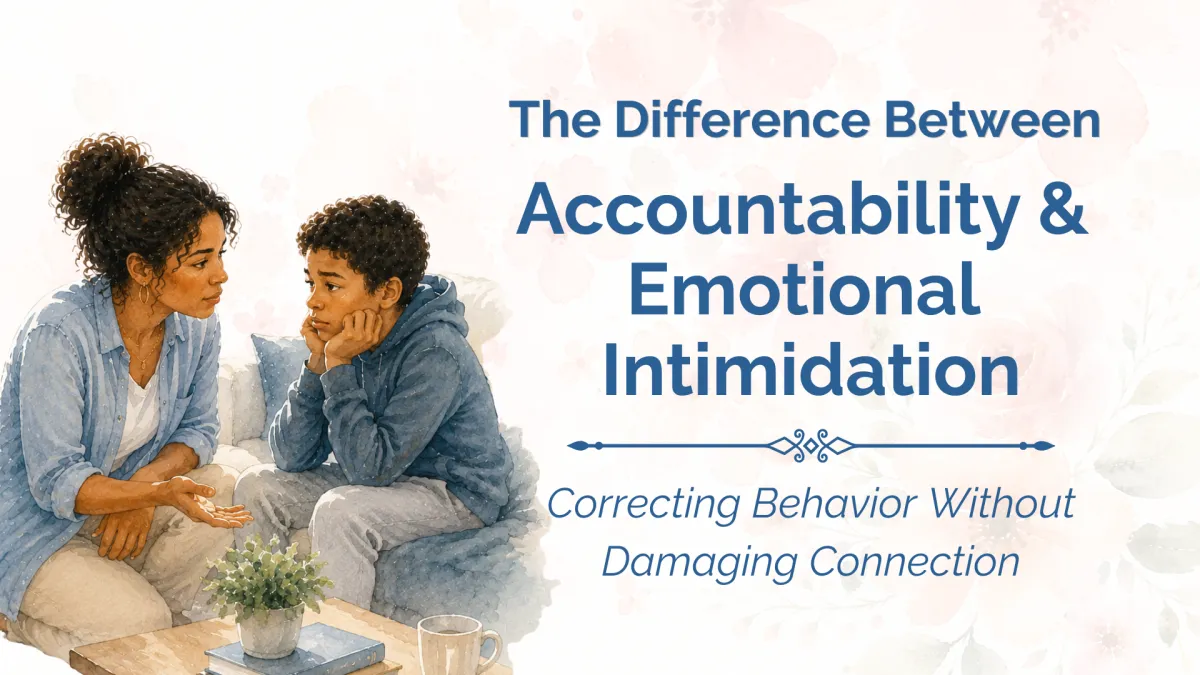
The Difference Between Accountability and Emotional Intimidation
Most parents have had a moment when correction went further than they intended.
You asked your child to do something. They ignored you. You asked again. Then came the argument, the attitude, or the behavior you've already corrected more times than you can count. Before long, you're no longer simply addressing what your child did. You're angry, they're upset, and the entire interaction has become much bigger than the original problem.
Sometimes we tell ourselves that our children need to understand how serious we are.
And sometimes they do.
Children need correction. They need boundaries, consequences, and parents who are willing to say, “No, that behavior is not acceptable.”
But there is a difference between holding a child accountable and making a child afraid of our reaction.
Understanding that difference doesn't require us to become permissive. It helps us correct our children in a way that actually teaches what we want them to learn.
Accountability Doesn't Remove the Boundary
Healthy accountability begins with truth.
Something happened. A rule was broken, someone was hurt, a responsibility was neglected, or a choice was made that needs to be addressed.
We don't need to minimize that in order to respond calmly.
If your child deliberately broke something, lied about homework, spoke disrespectfully, or ignored a clear instruction, you can name the behavior plainly:
“That wasn't truthful.”
“You were told to put the tablet away, and you chose to keep using it.”
“You may be angry with your sister, but you may not speak to her that way.”
“You made the mess, so you're responsible for helping clean it.”
Notice what those statements don't require.
Yelling doesn't make the boundary clearer. Humiliation doesn't make the behavior more wrong. A ten-minute lecture doesn't necessarily make the lesson more memorable.
The truth can stand without our emotions having to make it bigger.
When Correction Becomes Intimidation
There is a difference between a child being unhappy about correction and a child being afraid of the person correcting them.
Children won't enjoy every consequence. They may cry, become frustrated, or insist that something isn't fair. Their discomfort doesn't automatically mean we've done something wrong.
Emotional intimidation is different.
Correction begins moving toward intimidation when we use our anger, words, withdrawal, threats, ridicule, or physical presence to make a child feel emotionally overpowered.
It can sound like attacking the child instead of addressing the behavior:
“What is wrong with you?”
“You ruin everything.”
“You're such a liar.”
“You'd better wipe that look off your face.”
It can also happen when consequences become unpredictable because they depend more on how angry the parent feels than on what the child actually did.
At that point, the lesson can begin to change.
Instead of learning, I need to take responsibility for what I did, the child may become primarily concerned with, How do I keep Mom or Dad from getting that angry again?
That's not the lesson we were trying to teach.
Fear Can Get a Fast Response
This is one reason emotional intensity can be deceptive.
Sometimes it works.
Raise your voice loudly enough and a child may stop immediately. Make the consequence frightening enough and you may get quick compliance. A child who fears your reaction may become extremely careful about what they say and do around you.
From the outside, that can look like obedience.
But Scripture calls parents to something deeper than controlling outward behavior.
Ephesians 6:4 tells fathers:
“Do not exasperate your children; instead, bring them up in the training and instruction of the Lord.”
Correction has a purpose. We are training and instructing.
That requires us to think beyond How do I make this behavior stop right now? and consider What does my child need to learn from this?
Sometimes immediate compliance is necessary, particularly when safety is involved. But over time, our goal is much larger. We want children to develop wisdom, self-control, honesty, responsibility, and an understanding of right and wrong that eventually functions without us standing over them.
Fear alone cannot produce that kind of maturity.
Calm Doesn't Mean Permissive
This is where conversations about emotional safety can easily become confusing.
A calm parent can still say no.
A calm parent can remove a privilege, require restitution, insist that a responsibility be completed, interrupt disrespectful behavior, or impose an appropriate consequence.
You don't have to choose between being gentle and having authority.
In fact, calmness can make authority clearer because the child isn't trying to sort through the parent's emotional reaction at the same time they're being corrected.
Consider the difference between:
“You never listen to me! How many times do I have to tell you?”
and:
“I gave you an instruction, and you chose not to follow it. Put the game away now.”
The second response isn't softer about the expectation.
It's simply clearer.
Correct the Behavior Without Defining the Child by It
Words spoken during correction can stay with children for a long time.
That's why we need to distinguish between naming what a child did and assigning that behavior to their identity.
There is a difference between saying, “You lied to me,” and “You're a liar.”
There is a difference between, “That was a selfish choice,” and “You're selfish.”
One addresses something that needs to change. The other tells the child who they are.
Our children will make foolish choices. They will sin. They will sometimes knowingly disobey, speak disrespectfully, hide what they've done, or make the same mistake after we've already taught them better.
We don't need to pretend otherwise.
But our correction should help them recognize wrongdoing, take responsibility, make things right when possible, and learn what to do differently next time.
Shame isn't required for any of those things.
Consequences Should Teach, Not Simply Hurt
When we're angry, it can be tempting to choose a consequence based on how upset we are.
Healthy accountability asks a different question:
What response makes sense for what happened?
A child who intentionally makes a mess can help clean it. A child who misuses a privilege may lose access to it for an appropriate period. A child who damages something may need to participate in repairing or replacing it. A child who hurts someone may need to apologize and make restitution where possible.
Not every consequence can connect perfectly to the behavior, and parents need flexibility depending on a child's age and the seriousness of what happened.
But consequences should have a purpose beyond making a child miserable enough to remember never to do it again.
Discipline is supposed to teach.
What If You Already Lost Your Temper?
You will.
Maybe not today, but if you're parenting children for any length of time, there will be moments when you respond in a way you wish you hadn't.
What matters is what you do next.
Apologizing to your child doesn't surrender your authority.
You can say:
“I was right to correct what you did, but I was wrong to yell at you the way I did. Will you forgive me?”
Notice that you don't have to erase the original boundary in order to take responsibility for your own behavior.
Your child can still receive a consequence.
And you can still repent when your response was sinful.
In fact, that may become one of the most important lessons you teach about accountability.
Accountability applies to us too.
Our children need to see that following Christ doesn't mean pretending we're always right. It means being willing to acknowledge our sin, seek forgiveness, and make things right.
Jesus Is Not a Model for “Gentle Parenting”
I would be cautious about reducing Jesus to a parenting philosophy.
Jesus was compassionate, but He also spoke hard truth. He confronted sin, called people to repentance, and never confused grace with pretending wrongdoing didn't matter.
John 1:14 describes Him as “full of grace and truth.”
That combination matters for Christian parents.
Truth without grace can become harsh and condemning. Grace without truth can become permission to avoid necessary correction.
Our children need both.
We tell the truth about what is wrong, hold appropriate boundaries, and require responsibility. At the same time, we remember that the child standing in front of us is not a problem to overpower.
They are a person we have been entrusted to teach.
Take an Honest Look at Your Own Patterns
This isn't about examining every moment you've ever raised your voice and deciding you've damaged your child.
Parents become frustrated. Children can be extraordinarily frustrating. One difficult interaction doesn't define the culture of your home.
Patterns matter more.
Consider what correction typically feels like in your family.
Can your child predict what will happen when a rule is broken, or does the response depend heavily on your mood?
When you're angry, do you address the behavior or begin attacking character?
Can your child admit wrongdoing without fearing humiliation?
Do you follow through on consequences consistently, or do you sometimes threaten things you don't intend to enforce?
And when you get something wrong, are you willing to take responsibility too?
Those questions aren't intended to produce guilt.
They're opportunities to become more intentional about the kind of leadership we're providing.
Accountability Has a Larger Goal
We aren't raising children simply to make childhood easier.
Eventually, our children will leave our direct authority.
We want them to become adults who tell the truth when no one is checking, accept responsibility when they've done something wrong, respect appropriate authority, make wise decisions, repent when they sin, and understand that actions have consequences.
That kind of maturity develops over years.
Our correction today is part of that process.
So hold the boundary. Follow through. Say no when no is necessary. Require your child to make something right when they've done wrong.
But don't mistake emotional intensity for authority.
Accountability teaches a child to take responsibility for what they have done. Emotional intimidation makes the parent's reaction the center of the lesson.
Our goal is not to make our children afraid enough to behave.
It is to faithfully teach them how to live in truth and wisdom.
Something to Think About
When correction becomes difficult in your home, what tends to happen to your own response?
Are there places where you need to become more consistent with boundaries? Are there places where frustration has begun doing the work that calm authority should be doing?
Ask God to show you one area where your correction can become clearer, steadier, and more purposeful.
Prayer
Father, give me wisdom as I correct and teach my child. Help me hold boundaries without allowing anger to control my response. Guard my words when I am frustrated, and show me when I need to repent and ask forgiveness. Help me lead with both truth and grace, taking wrongdoing seriously while remembering the responsibility You have given me to instruct my child with wisdom. In Jesus' name, amen.
When Dishonesty Is Part of the Struggle
If your child's dishonesty has left you wondering what may be happening beneath the behavior, What Is Really Happening When Your Child Lies will help you consider some of the reasons children hide mistakes or avoid telling the truth and how you can respond wisely.
→ Download the Free Parenting Guide
If you're looking for additional help creating a home where correction, connection, boundaries, and emotional safety can coexist, the Emotional Safety Toolkit offers practical support for those everyday parenting moments.