
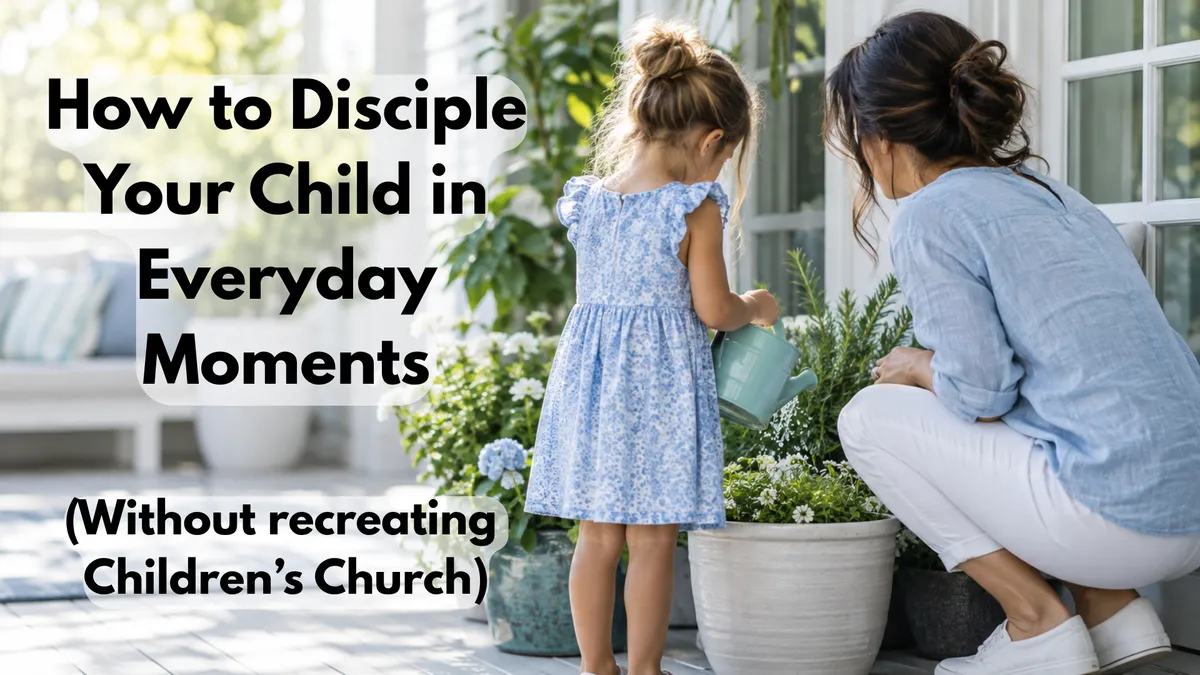
How to Disciple Your Children in Everyday Moments (Without Recreating Sunday School)
Family discipleship doesn't require a perfectly organized devotional time. God gives us opportunities to teach our children throughout ordinary life.
That may be the most freeing sentence a tired Christian parent can hear. So many of us want our children to know God personally, and we've been told that discipleship begins at home. We believe it. We just aren't sure what it's supposed to look like on a Tuesday night when dinner is late and everyone is worn out.
This post is for the parent who has tried to do it "right" and come away discouraged. There is a better picture, and it comes straight from Scripture.
Why So Many Parents Get Stuck
When we hear that we're supposed to disciple our children at home, most of us immediately picture another thing to organize. A curriculum. A family devotional book. Everyone sitting quietly around the table while one parent delivers a well-prepared Bible lesson.
There's nothing wrong with any of those things. The trouble is that we start to believe discipleship only counts when it looks like that. And because that picture is hard to pull off with young children, we quietly conclude that we're not doing it at all.
When the Devotional Doesn't Look Like the Picture
If you've tried a family devotional with little ones, you probably know how it goes. One child is upside down in the chair. Somebody needs a snack. Another child has decided this is the perfect moment for an unrelated story that takes eleven minutes. Meanwhile you're wondering why your family doesn't look like the family on the front of the devotional book.
That experience is very common, and it doesn't mean you've failed. Young children wiggle, interrupt and drift. That's how they're made. A setting that asks them to sit still and listen for a long stretch will always be a struggle, and the struggle can leave a parent feeling guilty about something that was never the whole point.
Deuteronomy 6 Describes Life, Not a Classroom
The clearest picture of family discipleship in the Bible doesn't look like a classroom at all.
"These commandments that I give you today are to be on your hearts. Impress them on your children. Talk about them when you sit at home and when you walk along the road, when you lie down and when you get up." Deuteronomy 6:6-7 (NIV)
Look at the settings in that verse. Sitting at home, walking along the road, lying down, getting up. These are the most ordinary parts of a day. For us, that's the kitchen table, the minivan, the school pickup line and bedtime.
God's commands are meant to be woven into the rhythm of family life, talked about naturally as life happens. That's good news for any parent who feels they don't have time for one more structured activity. The opportunities are already in your day.
Notice, too, that the passage begins with the parent's own heart. "These commandments... are to be on your hearts." Before we can impress God's Word on our children, it needs to be shaping us. That's why everyday discipleship flows so naturally from a parent's own walk with God.
Four Ordinary Moments That Count as Discipleship
Here are four everyday moments that are real discipleship, even though none of them would show up on a lesson plan.
1. A Conversation About Forgiveness After Siblings Fight
Sibling conflict is one of the most consistent features of family life. Once everyone has calmed down, it's an opening to talk about how God forgives us and asks us to forgive one another. Children learn more about forgiveness from walking through a real conflict with a loving parent than from any definition they might memorize.
A simple way to start is to ask each child what happened, help them name what was wrong, and then talk about what making it right looks like. Keep it short. The point is to connect the moment to God's truth, not to deliver a lecture.
2. Praying in the Car Because Your Child Is Nervous About a Test
When a child is anxious, they need to know they can bring that worry to God. A short prayer in the car on the way to school shows them that prayer is for real life, not only for church and bedtime.
You don't need special words. Something like, "Lord, You know [your child's name] is nervous about her spelling test. Please help her remember what she studied and help her trust You," is enough. Your child learns that God cares about the small things that feel big to them.
3. Thanking God for Something You Notice
Gratitude is one of the simplest ways to help children see God at work. When you notice a sunset, a kind neighbor, or a good report from school, thank God out loud for it.
Over time, children begin to notice these things themselves. They learn that good gifts come from God and that thanking Him is a normal part of life.
4. Apologizing to Your Child When You Were Wrong
This one surprises many parents. When you snap at your child, break a promise, or handle something poorly, a sincere apology teaches them what repentance looks like. They see that following Jesus means admitting when we're wrong and asking forgiveness, even when you're the grown-up.
A simple apology might sound like, "I was wrong to yell at you. I'm sorry. Will you forgive me? I'm going to ask God to help me be more patient." Few things show a child the gospel at work in real life quite as clearly.
Keep the Intentional Practices Too
None of this means you should stop reading Scripture or praying together on purpose. Intentional time in God's Word matters, and children benefit from hearing the Bible read aloud and from praying as a family.
The goal is to hold both. Read Scripture and pray together intentionally, and also notice the ordinary moments where faith can be talked about naturally. Don't let your hopes for a perfect devotional time keep you from the opportunities that are already in front of you.
It can help to keep intentional practices short and simple with young children. A few verses read aloud at breakfast, a short Bible story at bedtime, or a single question at dinner can be more sustainable than a long session that leaves everyone frustrated.
What Everyday Discipleship Looks Like at Different Ages
The moments look a little different depending on how old your children are, so it helps to match your approach to where they are.
Toddlers and preschoolers learn best through repetition, simple words and routine. Short prayers at the same times each day, a simple phrase like "God made that" when you notice something in nature, and singing a song about Jesus in the car are all meaningful at this age. Keep sentences short and concrete. A three-year-old won't follow a long explanation, but they'll remember that you thanked God for the rain every time it fell.
Early elementary children start asking more questions and noticing right and wrong in their own lives. This is a good age for brief conversations after conflicts, praying together about specific worries, and reading short Bible stories that connect to what they're facing.
Older elementary children can handle deeper conversations. They're beginning to think about friendships, fairness and their own choices. Ask them what they think, listen carefully, and help them connect what's happening in their lives to what Scripture teaches. At this age, your honesty about your own faith becomes especially important, because they're watching closely to see whether what you say matches how you live.
Whatever the age, the principle is the same. Take what your child is already experiencing and gently connect it to God's truth.
How to Start Noticing the Moments
If everyday discipleship is new to you, here are a few ways to begin:
Choose one setting to watch this week. Pick the car, the dinner table or bedtime, and look for one moment there to connect to God.
Listen before you teach. Many discipleship moments start with a question or a frustration from your child. Hear them out before you respond.
Keep it short. A sentence or two of truth is often enough. Children remember brief, real conversations.
Be honest when you don't know. If your child asks something you can't answer, say, "That's a good question. Let's find out together." That shows them faith involves seeking God, not having every answer ready.
Let it be imperfect. Some moments will go well and some won't. Small practices repeated over time are what build lasting faith.
Faith That Becomes Part of Ordinary Life
It's worth saying plainly that there is no parenting formula that guarantees a child's faith. Our part is faithfulness. God does what only God can do in a child's heart. That truth takes the pressure off. You're not responsible for producing a perfect outcome. You're invited to faithfully point your child to Jesus in the life you're already sharing.
Faith at home doesn't need to feel like another class. It needs to become part of ordinary life.
Next Steps
If you would like to take the next simple step, download my free guide 5 Simple Ways to Build Faith at Home.
If you want help understanding how to build faith naturally with young children, that's exactly what I teach in my course, Building Faith in Young Children. It's $67, and I'll show you practical, age-appropriate ways to build that foundation at home. You don't need to know the whole Bible, and you don't need a perfect devotional routine.