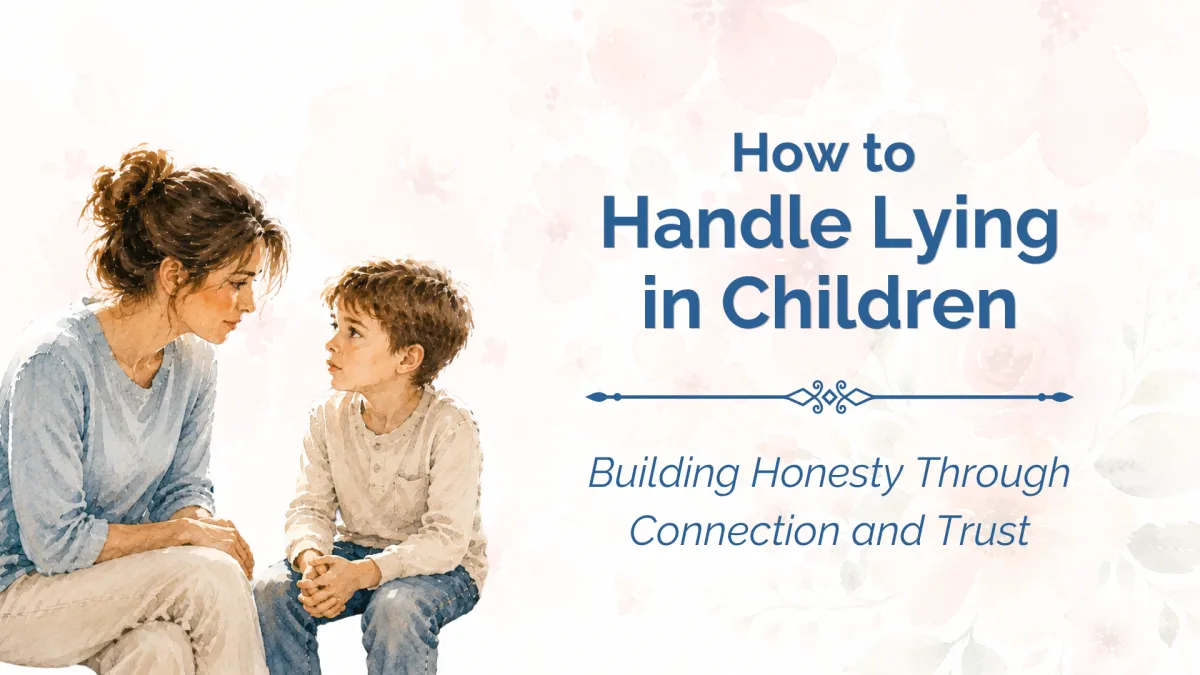
How to Handle Lying in Children Without Shame, Fear, or Power Struggles
When your child looks you in the eye and tells you something that isn't true, it gets your attention fast.
It can be unsettling, especially when honesty is something you've intentionally taught in your home. You may wonder why your child would lie when they know better, whether you can trust what they're telling you, or even what this behavior says about the kind of person they're becoming.
Those are understandable concerns, but if we respond only to the lie itself, we may miss an important opportunity to teach.
Children lie for different reasons, and those reasons change as they grow. A young child may deny something almost instinctively because they don't want to get in trouble. Another child may lie because they're embarrassed, afraid of disappointing you, or unsure how to admit what they've done. An older child may make a deliberate choice to hide something because they know there will be consequences.
None of those reasons makes dishonesty acceptable. Truth matters, and our children need us to teach them to tell it even when telling the truth is uncomfortable.
But teaching honesty requires more than catching a child in a lie and assigning a consequence. We need to help our children understand why truth matters, learn how to take responsibility when they've done something wrong, and discover that honesty is still the right choice when it costs them something.
As Christian parents, we have an even deeper reason for doing this. We are raising children to know and reflect the God of truth, and that goes further than raising children who don't lie.
First John 1:5 tells us, “God is light; in him there is no darkness at all.”
That gives us a much better starting place for dealing with lying. We can take dishonesty seriously without panicking over what one lie says about our child's future, and we can look beyond stopping the behavior long enough to ask an important question:
What does my child need to learn about walking in truth?
Why Children Lie
Why Do Children Lie?
There isn't one reason children lie.
Sometimes the reason is plain. They don't want to get in trouble. They know they weren't supposed to draw on the wall, take the cookie, hit their sibling, or play on the tablet, and denying it feels like the quickest way out of an uncomfortable situation.
Other times, something different is happening. A child may be embarrassed by what they did or worried about disappointing you. They may wish so strongly that something weren't true that denying it becomes their first response. Younger children are also still developing their understanding of truth, imagination, consequences, and other people's perspectives.
Age and development make a difference. A four-year-old telling an elaborate story about what happened is not necessarily doing the same thing as a twelve-year-old deliberately constructing a lie to conceal something. Both may need guidance toward honesty, but wise parenting asks us to understand the child in front of us rather than treating every untrue statement exactly the same way.
Truth Matters, and So Does How We Teach It
As Christian parents, we have a deeper reason for teaching honesty than wanting children who follow the rules.
First John 1:5 tells us, “God is light; in him there is no darkness at all.” Truth is consistent with the character of God, and Scripture repeatedly calls His people to walk in truth.
We want our children to become people who tell the truth even when telling it costs them something. That kind of character isn't developed through fear of being caught. It grows as children learn that honesty matters, wrongdoing can be acknowledged, forgiveness is real, and mistakes can be addressed rather than hidden.
That means our response to dishonesty matters too.
Ephesians 6:4 tells parents, “Do not exasperate your children; instead, bring them up in the training and instruction of the Lord.” Biblical discipline includes correction, but its purpose is instruction. In the moment, we are teaching our children how to respond truthfully the next time, along with stopping the behavior.
Don't Ask a Question When You Already Know the Answer
Here is one of the easiest changes parents can make.
If you watched your child draw on the wall, asking, “Did you draw on the wall?” creates an unnecessary opportunity to lie. You already know what happened.
Instead, say what you know: “I see that you drew on the wall. Markers are for paper, not walls. We need to clean this up.”
Now you can deal with the actual problem without creating a courtroom scene in your kitchen.
Of course, there will be plenty of situations when you don't know what happened. In those moments, asking questions is appropriate. But when the facts are already clear, we don't need to test whether our child will confess before we address the behavior.
When Your Child Does Lie, Stay Steady
Knowing why a child might lie doesn't mean ignoring dishonesty.
If your child tells you something you know isn't true, address it clearly.
You might say, “I know that's not what happened. I want you to tell me the truth, even when you've done something wrong.”
Then give your child an opportunity to try again.
For some children, especially younger ones, that second opportunity is important. They may have blurted out “No!” almost automatically because they were afraid of the consequence. Giving them a moment to correct themselves helps them practice the response we want them to learn.
Your tone counts here. If admitting the truth leads to yelling, humiliation, or an unpredictable reaction, a child can become increasingly focused on avoiding the parent's response rather than learning to take responsibility.
Calm doesn't mean permissive. You can be completely calm and still require your child to clean the wall, apologize to a sibling, return something they took, lose a privilege, or experience another reasonable consequence connected to what happened.
Make Room for Confession Without Removing Responsibility
We want our children to learn that telling the truth is always the right choice, but that doesn't mean honesty erases the consequences of what they did.
If your child breaks a rule and then admits it, you can appreciate the honesty while still addressing the behavior.
“Thank you for telling me the truth. You still need to clean up what you spilled, but I'm glad you told me what happened.”
Both halves of that sentence are important. If children learn that telling the truth automatically gets them out of consequences, honesty can become another strategy for avoiding responsibility. But if telling the truth makes absolutely no difference in how we respond, we miss an opportunity to reinforce the courage it sometimes takes to admit wrongdoing.
We can hold both things together. What you did needs to be addressed, and I am glad you told me the truth.
Teach Your Child What to Say Instead
Sometimes we tell children, “Don't lie,” without teaching them what honesty sounds like when they've made a mistake.
Give them the words.
If your child immediately denies something, you can help them start again: “Try saying, ‘I did it, and I'm sorry.’”
Other useful phrases are simple: “I made a mistake.” “I forgot.” “I was afraid to tell you.” “I don't know.” “I need help.”
Pay special attention to “I don't know.” Children may lie because they believe they need to have an answer. Teaching a child that “I don't know” is an acceptable truthful response gives them another option besides making something up.
These aren't scripts children need to recite perfectly. They are language tools we can model until taking responsibility becomes easier.
Pay Attention When Lying Becomes a Pattern
An occasional lie and a persistent pattern of dishonesty aren't the same thing.
If lying is happening frequently, it is worth becoming curious about what surrounds it. When does it usually happen? Is your child trying to avoid a particular consequence? Does it happen around schoolwork, friendships, food, technology, or one specific expectation? Has something changed recently?
Understanding the pattern doesn't excuse dishonesty. It helps you address the right problem.
Sometimes a child needs firmer and more consistent boundaries. Sometimes expectations haven't been as clear as we thought they were. Sometimes fear, shame, impulsivity, or developmental differences are contributing to what we're seeing.
We can correct the lie while still asking what our child needs to learn in order to handle that situation differently next time.
Our Children Need to Know What Happens After the Truth Comes Out
One of the most important things we can teach children about honesty is what happens after they admit they were wrong. We deal with what happened, make amends where we can, ask forgiveness when necessary, and then move forward.
For Christian families, this gives us an opportunity to teach something much larger than honesty. Our children need to understand sin, repentance, forgiveness, and grace. They need to know that bringing wrongdoing into the light isn't the end of the relationship.
The gospel gives us a reason to tell the truth about ourselves because we don't have to pretend we never get things wrong.
That doesn't eliminate discipline. It gives discipline a purpose beyond punishment.
We are raising children who will eventually make choices without us standing beside them. We want them to become people who value truth because they know and follow the God of truth, and not only because Mom will find out anyway.
Something to Think About
When your child lies, what happens next in your home? Consider whether your response is helping your child learn to take responsibility and tell the truth the next time, not only making dishonesty stop in the moment.
Ask God for wisdom to know when your child needs correction, when they need help finding the words to tell the truth, and how you can consistently hold truth and grace together.
Prayer
Father, You are a God of truth, and I want my child to learn to walk in truth. Give me wisdom when dishonesty happens and help me respond with both clarity and self-control. Show me what my child needs to learn, help me correct without provoking fear or shame, and teach me to model honesty, repentance, forgiveness, and grace in our home. In Jesus' name, amen.
Want to go deeper?
Download my free guide, What Is Really Happening When Your Child Lies, for practical insights that help parents understand the fear, shame, and emotional overwhelm that often hide beneath dishonest behavior.
Looking for more support?
The Emotional Safety Toolkit helps Christian parents build trust, strengthen connection, respond calmly during difficult moments, and create an environment where honesty can grow. It includes practical tools, reflection questions, and faith-based guidance for everyday parenting challenges.