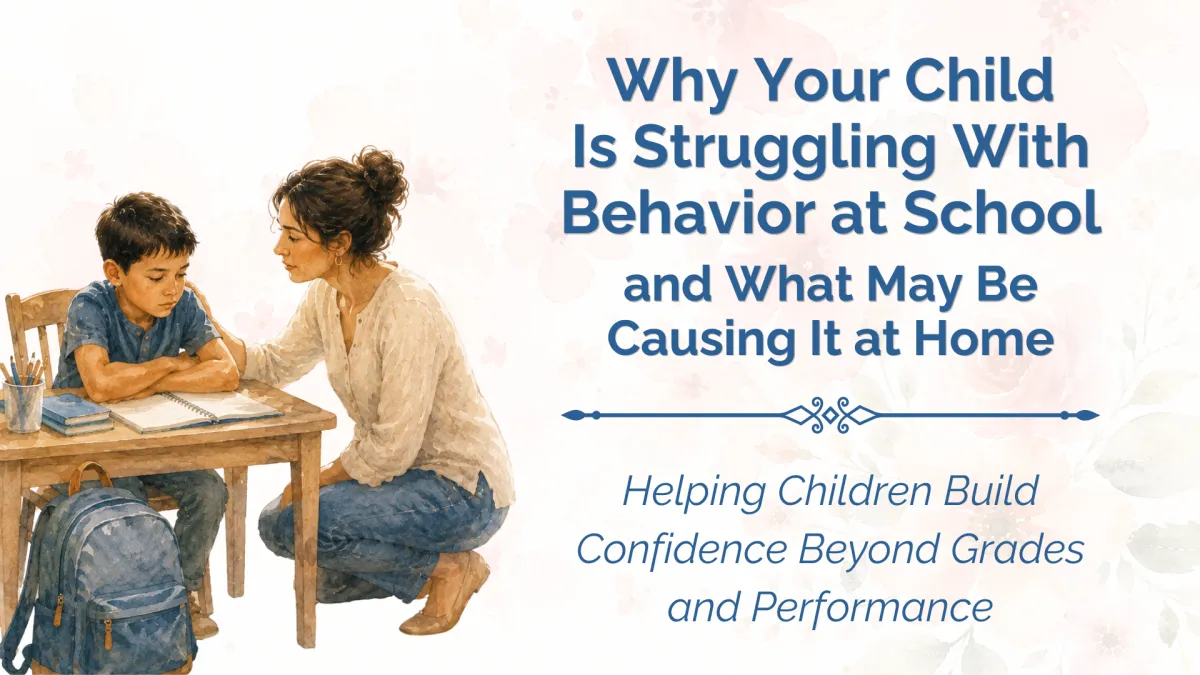
What Happens at Home Influences Classroom Behavior
What Happens at Home May Influence What Happens in the Classroom
When a child begins struggling with behavior at school, parents naturally look toward the classroom for answers. What happened with the teacher? Is there a problem with another student? Is the work too difficult? Why is my child suddenly getting in trouble?
Those are important questions, and sometimes the source of the problem is connected to something happening at school. But school is only one part of a child's day.
Children don't walk through the classroom door each morning and leave the rest of their lives behind them. They bring their sleep, routines, worries, habits, relationships, expectations, and developing ability to handle frustration right along with their backpacks.
That doesn't mean a child's behavior at school is automatically caused by something happening at home. It does mean that when behavior becomes a pattern, home is one of the places worth looking.
Proverbs 4:23 tells us:
“Above all else, guard your heart, for everything you do flows from it.”
As Christian parents, we care about more than getting our children to behave appropriately at school. We want to understand what they need so we can help them grow in wisdom, responsibility, self-control, and truth.
Start With the Whole Child
A teacher may tell you that your child is falling asleep during lessons, walking around the room, calling out, arguing with peers, refusing work, or becoming upset very quickly.
The behavior matters, but it doesn't tell us on its own why it is happening.
A child who puts his head down every afternoon may be exhausted. Another may be avoiding work he doesn't understand. A child who becomes angry quickly may need more help managing frustration, while another may be dealing with a difficult peer situation.
Sometimes the explanation is simpler. A child knows the expectation and doesn't want to follow it.
So be careful about immediately deciding what a behavior means. Look at the whole picture and consider whether something in your child's life outside the classroom could be making school more difficult.
1. Take an Honest Look at Sleep
If I could ask parents to check one practical thing when a child is regularly tired, irritable, or struggling to focus at school, sleep would be high on the list.
School asks a lot of children. They have to listen, remember directions, transition between activities, complete work, interact appropriately with other children, manage disappointment, and control impulses for hours at a time. All of that is harder when they're exhausted.
Look at what time your child falls asleep, which can be later than the time they go to bed. Consider whether screens, activities, homework, or inconsistent routines are keeping bedtime later than you realize.
You don't have to overhaul the entire household. If sleep appears to be a problem, start by making bedtime more predictable and adjusting the evening routine where needed. Then pay attention to whether anything changes.
2. Consider What Evenings and Mornings Feel Like
Children benefit from knowing what comes next. That doesn't require a rigid schedule where every minute is planned, but predictable routines can make everyday responsibilities easier to manage.
If every morning involves searching for shoes, unfinished homework, arguments about getting dressed, and racing out the door, your child may arrive at school already frustrated. If bedtime changes dramatically from night to night, mornings may become even harder.
Look for the part of your routine that consistently creates the most difficulty and start there.
Perhaps backpacks can be packed the night before. Clothes can be chosen ahead of time. Maybe bedtime needs to become more consistent, or screens need to go off earlier so everyone has time to settle.
Small changes at home won't solve every school behavior problem, but reducing unnecessary chaos can give a child a better starting point for the day.
3. Make Sure Expectations Are Clear
Sometimes adults believe we've been clear because we've said something many times: “Behave at school.” “Listen to your teacher.” “Make good choices.” We understand what those phrases mean, but a child may need something much more specific.
What does respect sound like when a teacher corrects you? What should you do when another student makes you angry? What do you do when you don't understand your work? What does following directions look like when you don't agree with the direction?
Those are teachable skills. Instead of saying, “You need to stop getting in trouble for arguing,” you might practice a response your child can use:
“If you're upset with something your teacher says, follow the direction and ask if you can talk about it privately afterward.”
Clear expectations give children something concrete to practice, beyond telling them what not to do.
4. Look at How Your Child Handles Frustration at Home
School provides plenty of opportunities for frustration. A child loses a game, gets an answer wrong, has to stop a preferred activity, doesn't get chosen first, receives correction, or has to complete work they don't enjoy.
Think about what happens when similar frustrations occur at home.
Does your child immediately argue when told no? Do they give up when something feels difficult? Can they recover after disappointment, or does one problem affect the rest of the evening? Those patterns can give you useful information.
Children aren't born knowing how to handle every difficult emotion appropriately. Self-control develops over time, and some children need more explicit teaching and practice.
When everyone is calm, help your child identify what they can do when frustration begins to rise. They may need to pause before speaking, ask for help, take a few slow breaths, or learn a respectful phrase for expressing disagreement.
Practice at home gives them a better chance of using those skills when the classroom gets difficult.
5. Pay Attention to Screen Habits Without Blaming Everything on Screens
Screens are part of most children's lives, so declaring them the cause of every attention or behavior problem isn't very helpful. It is still worth looking at how they're being used.
Are screens interfering with sleep? Does your child have difficulty transitioning away from a game or device? Is screen use replacing physical activity, conversation, homework, or other responsibilities? Is highly stimulating content immediately before bed making it harder for your child to settle?
If you notice a problem, establish a clear boundary around the specific issue rather than making screens the villain.
For example, you might create a consistent evening cutoff so your child has time to wind down before sleep.
The goal is making sure technology isn't controlling the rhythm of your home, not eliminating it.
6. Connection and Correction Both Matter
When school behavior becomes difficult, family conversations can quickly become dominated by correction.
“How was school?”
“Did you get in trouble?”
“What did your teacher say?”
“Did you finish your work?”
Those questions may be necessary, but your child also needs interactions with you that aren't centered on what went wrong.
Spend time talking about other things. Listen to what your child is interested in. Laugh together. Ask about something they enjoyed. Give them opportunities to experience your attention when there isn't a problem to solve.
Connection doesn't eliminate the need for consequences, nor does a strong relationship guarantee good behavior. It does give you a stronger foundation from which to teach, correct, listen, and guide.
Home Isn't Always the Answer
You can have consistent routines, reasonable screen limits, a predictable bedtime, clear expectations, and a strong relationship with your child and still receive a call from school.
If the behavior continues, don't assume you need to become stricter or improve your parenting. Look at what is happening at school too.
Is the work appropriate for your child? Does the behavior occur during a particular subject? Is there a peer conflict? Has something changed in the classroom? Is your child struggling academically? Is there a skill they haven't developed yet? Does the pattern suggest that additional support or evaluation might be helpful?
Home and school aren't competing explanations. Sometimes both are contributing pieces of the same puzzle.
We Are Guiding More Than Behavior
Our goal is bigger than raising children who never get in trouble at school. We're raising children who are learning to take responsibility, tell the truth, manage frustration, respect others, make wise choices, and respond appropriately when they get something wrong.
Those lessons don't develop from one conversation after a bad day at school. They're formed through hundreds of ordinary moments at home, at school, and everywhere in between, so the everyday work counts. We correct when correction is needed. We teach skills that haven't developed yet. We establish boundaries and follow through. We listen before assuming we know what happened. We work with teachers and other professionals when additional support is needed.
And through all of it, we continue pointing our children toward the wisdom and truth of God.
Something to Think About
If your child is struggling at school right now, consider one question before deciding what needs to change: Is there anything happening at home that may be making the school day harder than it needs to be?
Maybe the answer is sleep. Perhaps mornings have become chaotic, expectations need to be clearer, or your child needs more practice handling frustration.
And perhaps the answer is no. That's useful information too, because it means it's time to keep asking questions and look more closely at what is happening during the school day.
Prayer
Father, give me wisdom to see my child clearly and not jump to conclusions when problems arise. Show me where our routines, expectations, or habits at home may need attention, and help me recognize when something else is contributing to my child's struggles. Give me patience to teach what needs to be learned, courage to hold appropriate boundaries, and wisdom to know when to seek additional help. Help me guide my child toward responsibility, self-control, truth, and wisdom. In Jesus' name, amen.
When You Need to Look More Closely at School Behavior
If you're trying to determine why a behavior keeps happening and what your child may need, read:
→ When Your Child Is Struggling With Behavior at School
That article will help you look more closely at patterns, academic demands, peer relationships, teacher observations, and other factors that may be contributing to what you're seeing.
And if dishonesty has become part of the struggle: